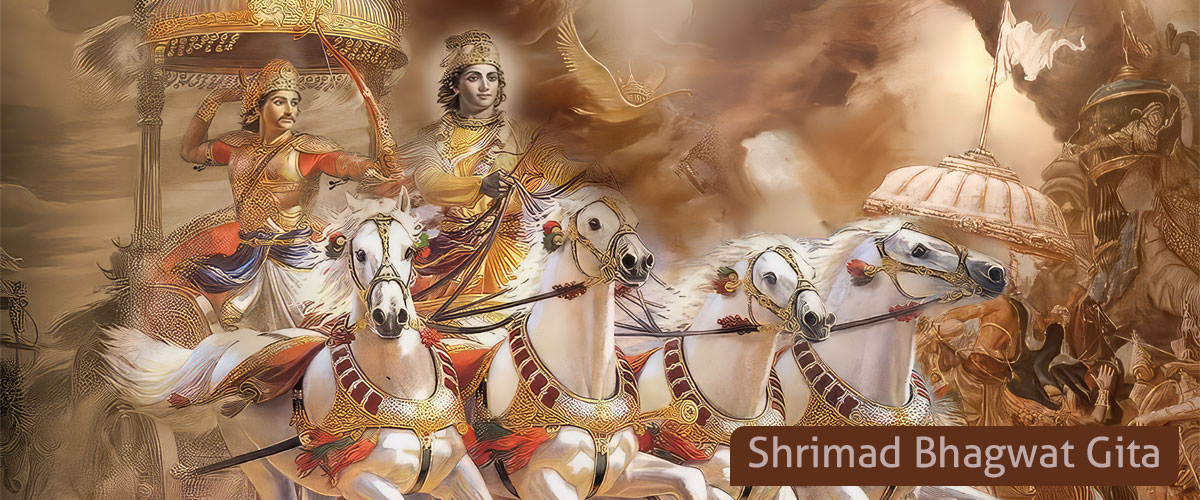
Chapter 9 – Raja Vidya Rāja Guhya Yoga
The Lord declares to Arjuna that He will now teach the most sacred and the most secretive knowledge. It is considered secretive because it is not within everyone’s grasp to comprehend. Even if this knowledge is imparted to all, those unable to understand it will still find it “secretive.” Hence, this secretiveness does not arise from exclusivity of audience, but from the inability of most people to comprehend the subject.
So, is this knowledge too complicated? No - it is not, if one possesses certain virtues such as Śraddhā (faith and conviction), Bhakti (devotion), and follows the principles of Karma Yoga that the Lord outlined in earlier chapters (Chapters 2 and 3).
To Arjuna, Jagatguru Krishna says He will bestow both knowledge and the experience of it, which will free him from all miseries of life. You may wonder - why only Arjuna? Why not me? When will I learn this knowledge? Remember, Arjuna represents all of us. If you, too, are as sincere as Arjuna; if you have the same conviction in the Lord; if you have completely surrendered yourself, asking Him to show you the light - then you too shall receive this most sacred knowledge and its experience. On the other hand, without these qualities, one cannot truly understand or experience this profound wisdom.
What is this knowledge all about?
This knowledge concerns the infinite, all-pervading, governing principle of all existence. How does one define the infinite? How do we perceive its vastness or its boundless power? The finite nature of our thoughts, driven by our limited sense organs, fails miserably to comprehend such a concept. The Lord therefore uses apparent contradictions to illustrate the limits of human cognition - and to emphasize the need to seek beyond them.
How can one understand this Supreme, Infinite Principle - the ‘Purusha’?
Lord Krishna declares that He, in His pure, original, unmanifested form of energy, pervades the entire existence. All of creation exists in Him, but He is not confined within them. That is, the Supreme Being is not limited by any individual body nor bound to it - just as countless creatures live in the ocean, yet the ocean itself cannot be contained within them.
Before one assumes to have grasped what “infinite” truly means, the Lord adds:
“Listen to My yogic power - creation is not within Me, nor do I dwell in them, yet I am the nourisher of all, and all arise from Me.”
At first, this may sound contradictory. Earlier, He said all creation exists in Him; now He says creation is not within Him. The emphasis here is that one should not limit one’s understanding of the infinite to the tangible or visible.
Take the ocean, for instance: for the creatures living within it to assume that their immediate surroundings define the entirety of the ocean is a limitation of perception. The ocean is far greater - it exists also as polar ice, as clouds formed from its evaporation, as waves crashing upon shores, and as the dark abyss reaching the sea floor.
The implicit message: do not rely solely on your sense organs to understand the infinite. The principle of awareness within us must transcend sensory experience to grasp the Supreme Being’s infinite nature.
The Lord gives another example - the wind. The mighty wind blows everywhere, yet it always rests in space. Similarly, all beings rest in Me, though I am much more than the wind and unaffected by it.
What defines existence? Since when does it exist, and until when will it exist?
The Lord explains the cyclical nature of existence. He states clearly that at the end of a Kalpa, the entire creation dissolves into Him, and He initiates creation again at the beginning of the next Kalpa.
(Kalpa is a measure of time spanning billions of years — details are beyond this summary, but can be found in various scriptural sources.)
The key point: the universe itself undergoes continuous cycles of birth and dissolution.
The Lord further explains - “By means of My Prakriti (creative energy), I create all beings again and again. I am the source of repeated annihilation as well. Yet, I am not bound by this process - I remain detached and indifferent.”
It is Prakriti, acting under His supervision, that brings forth creation and maintains these cycles.
So what is Prakriti?
It is that inseparable part of the Lord’s energy, always residing within Him, responsible for the various manifestations of material existence - much like how the body and its experiences exist for the soul. The body changes, yet the soul remains unaffected, lending support to the body’s existence. The same principle operates at every level of existence.
This may sound abstract, especially to a mind trained in Western scientific thinking, which relies on tangible evidence. Such an approach, though valuable, limits exploration into realms beyond sensory experience. To truly understand these principles, one must break free from these mental constraints — only then can one experience the infinite, for words alone can never define it.
The Process to Explore and Experience the Supreme, Infinite Principle
The Lord then elaborates on how one can experience the various facets of this Supreme Being.
He begins by addressing the ignorance one must overcome - the failure to recognize the divinity within oneself simply because it appears confined to a body. This ignorance gives rise to all delusion.
A true seeker, however, strives for this experience with full conviction and devotion, constantly engaging in acts of worship and remembrance. Worship here should be understood not merely as ritual, but as continuous, focused seeking - the constant remembrance of the Lord through thought, word, and deed. Singing bhajans and kirtans are means to recall His infinite attributes.
As with any subject, knowledge deepens through consistent engagement and contemplation — and the same applies here.
How do we direct all our thoughts toward this exploration of truth?
Now that the process is outlined, the Lord explains what to contemplate upon - His all-pervading presence.
He is the father, the mother, and the supporter of all existence. The syllable ॐ, the essence of all the Vedas - they all represent the same Supreme Being. He is the goal of all knowledge, the master of all laws, the witness of all time. He is creation and destruction, the source of all.
“I am the heat, the rain, the drought, immortality and death - both existence and non-existence; all arise from Me.”
Through these declarations, the Lord shows us how to perceive His divinity in everything we encounter - ensuring that we are never separated from the awareness of His presence.
In the final verses, the Lord distinguishes between the lower energies derived from Prakriti and His higher, supreme nature. Scriptures describe various rituals aimed at achieving worldly pleasure - one may pursue them, but material pleasures are fleeting and finite. They eventually end, compelling one to act again in pursuit of more.
If liberation (moksha) is your goal - freedom from endless cycles of desire, action, and result; of birth and death - then you must seek the Supreme Being.
As long as you seek the Lord with utmost sincerity and dedication, He will aid your journey toward realization. The Lord again emphasizes dedicating all actions to Him - for only this can destroy the ego, the greatest obstacle in experiencing the Divine.
In the closing verse, the Lord declares:
“Engage every thought and every action in Me - and you shall certainly experience Me.”
DISCLAIMER:
This is our sincere attempt to summarize the Gitopadesha through a series of short blogs. This is not a full translation or commentary of the divine book. We seek forgiveness from the reader and the Lord for inevitable omissions. The write-ups include personal opinions and summarized shlokas from the Bhagavad Gita. The intent is not to provide commentary but to inspire readers to study the Bhagavad Gita in its entirety. The writer is neither a scholar nor a hermit – somewhere in between – believing that the Lord guides his actions, though he may still err. Please forgive any mistakes
