This chapter is dedicated to setting the context for the reader, about when and why this upadésha (teaching) was given by Lord Krishna.
The chapter begins with the question from Dhritarāshtra, the old, blind king, father of Duryodhana. He asks Sanjaya, about what is happening at the battlefield – ‘dharma kshetra’, named ‘Kurukshetra’.
The fact it starts with word ‘dharma kshetra’ signifies that it was a land of dharma, and the battle is for the sake of dharma. It is interesting to note that king Dhritarāshtra is using the word ‘dharma kshetra’, although he was on the side of ‘adharma’ – by being one of the prime motivators of Duryodhana in waging the war. We often interpret Dharma according to what is convenient and beneficial to us! Dhritarāshtra did just that - believing he was right in wishing well for his son, without any concern for righteousness or justice.
Isn’t this a classic problem that plagues all of humankind? – Whether it is the law of the land or the sacred texts of religion, when we defy the spirit of the rule and make our own interpretations, doom is inevitable, sooner or later. Dhritarāshtra, here, was blinded not only by his lack of vision, but also by his greed wanting the kingdom solely for Duryodhana.
This is reflected in the very second line -“māmakāh pāndavāh chaiva” - where he asks what “my people” and the Pāndavās are doing. Though both the Kauravas and Pāndavās were his own family, referring only to the Kauravas as “my people” exposes his móha (obsessive attachment) to his son - the root cause of this great war.
The next few stanzas elaborate on the many great warriors present on the battlefield - the Kaurava army led by Bhishma Pitāmaha and the Pāndava army led by Drupada. Without delving into the numerous prior events that led to this epic battle, the key takeaway is that this was a dharma yudha - a battle for upholding righteousness.
This carries a timeless message for all of us: we must always stand for what is right. Being a mute spectator or staying neutral is as good as being on the wrong side. Hence, the gathering of all the brave warriors - big and small - for the sake of dharma yudha. Which side they chose to fight for was, again, influenced by their own interpretation of dharma.
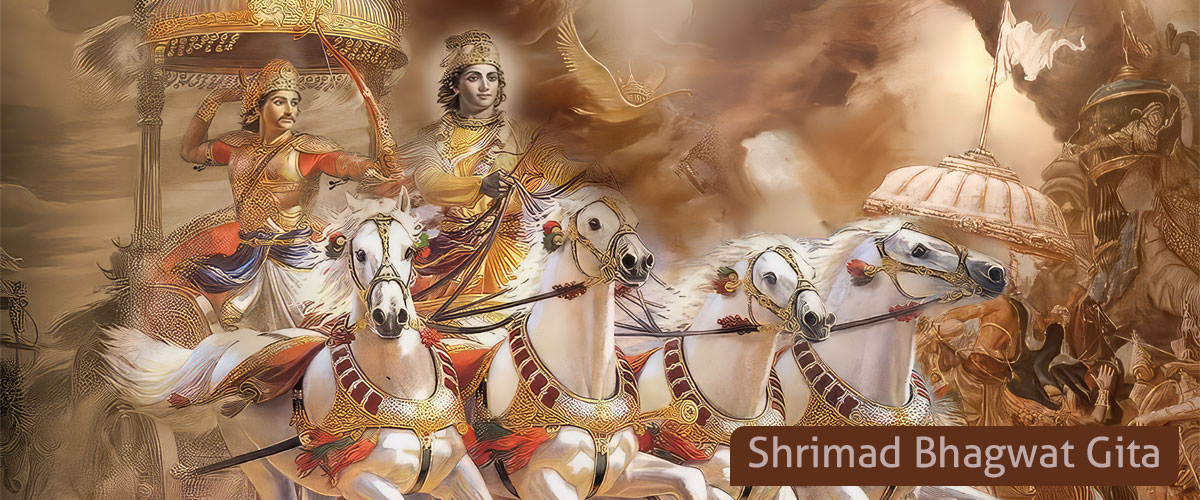
Arjuna, considered the greatest of archers, had Lord Krishna - his friend and guide - as his charioteer. Arjuna asked Krishna to place the chariot in the middle of the battlefield so he could assess both armies. The Lord, knowing well the temperament of Arjuna, chose to halt the chariot right before Bhishma Pitāmaha and Dronācharya - the two people Arjuna revered the most.
As Arjuna gazed upon the assembled warriors, he began to see them not as opponents, but through the lens of relationships - his gurus, brothers, uncles, and friends. Suddenly, Arjuna - the brave warrior of royal lineage - began to lose his composure, overwhelmed by emotion.
He then began to express his doubts, saying it was wrong to continue this battle and that he did not desire a kingdom gained at the cost of his loved ones’ lives. Even if the heavens themselves were promised, he would not fight, let alone for this earthly kingdom. Arjuna went on justifying his decision, shaping his own version of dharma to support his desire to withdraw from the war.
Don’t we all do this - arguing how we are always right? Of course, we consider ourselves good-hearted and righteous. But deep down, we know that sometimes, to save ourselves from the discomfort of being wrong, we twist our reasoning and find countless justifications to prove we were right all along - forming our own convenient version of Dharma. Eventually, we even start believing it completely!
But, Dharma cannot have different versions - there is only one, unambiguous truth. It is our intellect, clouded by self-interest, that interprets
dharma differently — almost always to suit our convenience.
So, what is this one, unambiguous version of Dharma?
There is no single-line answer. Lord Krishna unfolds its meaning across the remaining seventeen chapters, explaining the essence of dharma in all its depth
and glory. Knowing and practicing this truth, says the Lord Himself, leaves nothing else to be known or experienced. Dharma is not merely a concept - it
is a way of life. The Bhagavad Gita reveals the “why,” “what,” and “how” of
living it.
DISCLAIMER:
This is our sincere attempt to summarize the Gitopadesha through a series of short blogs. It is not a complete translation or commentary of the divine scripture. We humbly seek forgiveness from the reader and the Lord for any omissions, which are inevitable in keeping the blog concise.
The write-ups include both the author’s personal reflections and summarized interpretations of several shlokas from the Bhagavad Gita. The intent of this blog is not to interpret or comment on the Gita, but to inspire readers to explore it in its entirety.
The writer is neither a scholar nor a recluse — simply a seeker with firm faith that the Lord is the doer behind all actions. Being human, he continues to err. Kindly forgive him for all such mistakes.
