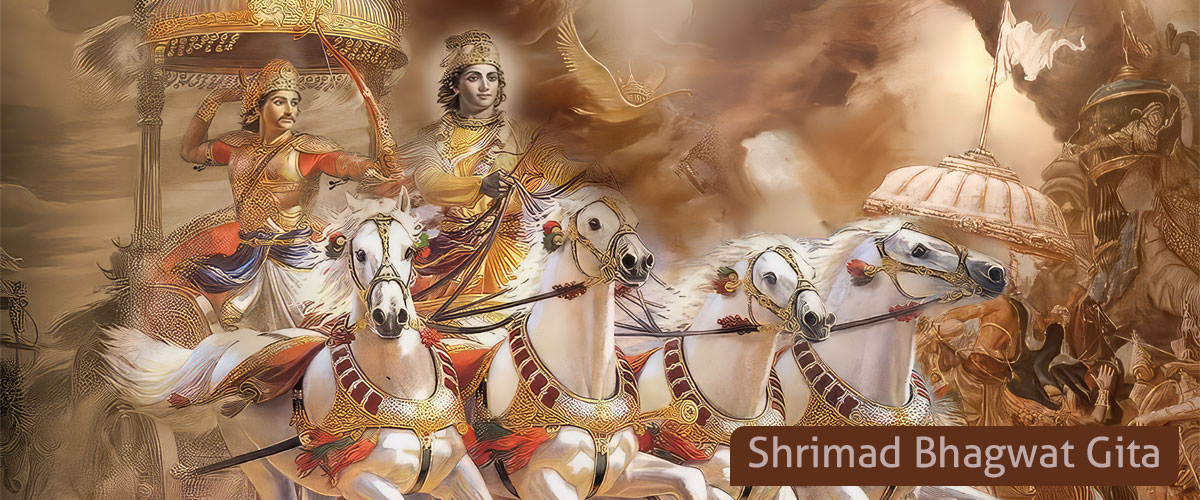
In this chapter, Lord Krishna explains in detail all about Dhyāna. The word Dhyāna loosely translates to “Meditation” in English. While meditation is a generic term used to denote deep contemplation, Dhyāna, on the other hand, is a well-defined process aimed at experiencing the divine truth - the truth of our existence and the true source of bliss.
One who seeks this experience of truth is referred to as a Yogi. The Lord begins by explaining who qualifies to be called a Yogi - one who has given up desires for the results of actions, yet remains relentlessly engaged in performing them. Such a person is a Yogi; not someone who sits idle. The Lord states that Sanyāsa (renunciation) and Yoga (discipline) mean the same - a person free from desires for self-gratification.
The Right Approach – Karma or Jñāna?
What is the right approach? Path of Karma (action), or Path of Jnāna (knowledge)?
Lord Krishna explains that these two paths are not exclusive of each other but rather complement one another. It is only through the path of action that one can ultimately tread the path of knowledge. From this point on, the Lord elaborates on the path of action.
He begins by dispelling common misunderstandings about the two key principles explained earlier - giving up expectations of results and renouncing material desires. At a surface level, one may think that not doing anything at all is the best option. To preempt such thoughts, the Lord explains that abstaining from action can never lead to contentment, nor can it lead one to true knowledge.
One cannot remain without performing actions even for a moment - this is the law of nature. Influenced by Prakriti (nature), every being is compelled to act. Sitting idle will not make the mind idle; rather, it will wander restlessly among countless thoughts born from unfulfilled desires. Thus, assuming that non-performance of action leads to wisdom is mere hypocrisy.
The only way to control the mind is by fully engaging it in rightful action. Performing actions is essential for life itself - even for our basic survival. Actions arise from desires, and desires are indeed difficult to manage. Desires lead to actions; the results of actions lead to further desires. This never-ending loop is called Karma Bandhana - bondage through action. So how can one break free from this cycle?
Yajña – The Way to Liberation from Karma Bandhana
The Lord introduces the concept of Yajña - a process that helps develop an attitude curtailing the rise of new desires. In simple terms, Yajña is the act of offering - giving up something to gain something else - performed selflessly as a bounden duty. Applying this Yajña spirit to all our actions is the key.
Lord Krishna explains that the Yajña spirit forms the very foundation of creation and existence. No being in this universe is entirely independent; all are intricately dependent upon one another for existence. Each being gives something up in exchange for something else. For example, we give up money to buy vegetables from a shop. At a deeper level, farmers give up their time and energy to grow those vegetables.
Yet, even if a farmer doubles his effort, the yield does not necessarily double - many other factors come into play: rainfall, soil fertility, worms that loosen the soil, bees that pollinate, and sometimes insects that may destroy the crop. The farmer knows he cannot demand results; he simply gives his time and energy, free from attachment to the outcome. Whatever result comes his way, he accepts it as it is - as a blessing.
This act of giving up expectations and accepting results gracefully transforms action into Yajña - a sacred sacrifice. The closer we look at nature, the clearer it becomes how futile the sense of entitlement truly is.
Through the evolution of civilization, humans have developed countless ways to mitigate risks, but in the process, they have cultivated a false sense of control. Yet, all these systems can collapse without warning - as the COVID-19 pandemic reminded us.
Therefore, we must transform all our actions into Yajñas, performed in a spirit of sacrifice and free from entitlement. By doing so, we learn to accept outcomes as divine blessings. This attitude naturally reduces the chain of desires. Indeed, this is the only way to break free from Karma Bandhana! How simple, yet how powerful Yajñas are, aren’t they?
How Do We Cultivate the Yajña Spirit?
Simple - yes. Powerful - yes. Practicing it? That’s difficult. But we should at least know the ideal so that we understand the goal. In fact, the Lord cautions people of wisdom not to unsettle others suddenly with these profound truths. If one is abruptly told to renounce desires and turn actions into sacrifices, it may create confusion and unrest in the mind. This change is not immediate; it is a gradual evolution of thought, born through continuous right action.
Understanding and performing one’s duties without reluctance is the most essential step. The attitude of Yajña develops gradually through small, consistent acts. Simple daily practices like folding our hands before the Lord, performing Pūjā, or singing Bhajans help nurture the mindset of offering. What we offer - whether material things, our mind, or our intellect - all play a role in transforming our consciousness. These actions may seem small, but they are deeply potent; we often fail to realize the values hidden in such practices.
The chapter concludes with the Lord emphasizing that the surge of desires and the sense of entitlement veil us from supreme knowledge - the experience of eternal bliss.
DISCLAIMER:
This is our humble attempt to summarize the Gitopadesha through a series of short blogs. This is not a complete translation or commentary on the divine scripture. We seek forgiveness from the reader and the Lord for any omissions made to keep the blog concise. The write-up includes both the writer’s personal reflections and summaries of several shlokas from the Bhagavad Gita. The intent is not to provide a commentary but to inspire readers to study the Bhagavad Gita in its entirety. The writer is neither a scholar nor a hermit, but someone who firmly believes that it is the Lord who enables all actions. Being human, he still errs. Kindly forgive him for all such mistakes.
