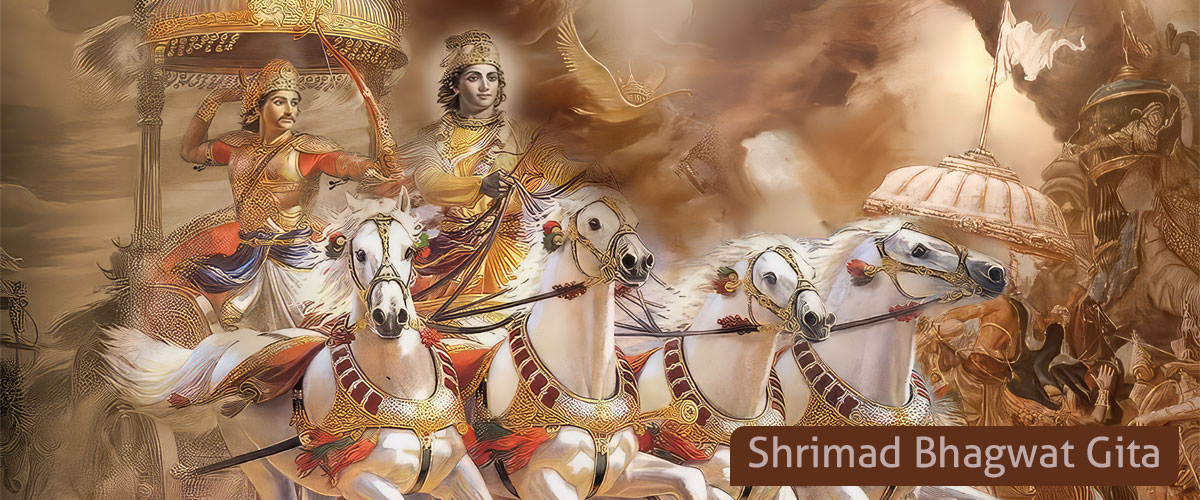
Throughout the first chapter, Lord Krishna doesn’t utter a word. As a good friend, he just lets Arjuna vent out his heart.
In this chapter, Arjuna is finally done expressing his despair and says to Krishna, “You tell me decisively - I am your disciple, and I will follow what you say.” This is where the real Upadeśa begins. Even though the Lord fully understands Arjuna’s state of mind, He still allows him to speak without interruption. Through this, He demonstrates the importance of listening patiently and offering advice only when the other person is ready to receive it.
Before we proceed, it’s important to have the right mindset while reading about killing. The Lord, in no way, promotes violence. If a murderer is punished with capital punishment, the hangman or the system of justice is not at fault for carrying out the sentence - the act of murder itself is wrong. As discussed in the first chapter, the setting of this Upadeśa is a battlefield - a fight to uphold dharma. Killing in such a battle is merely an eventuality.
So, what is Arjuna’s real problem? Having to fight and kill his own people. The Lord addresses this dilemma from several viewpoints. To keep this blog concise and engaging, we’ll cover this chapter in two parts.
The lord starts by setting the context of who we truly are. what is killed, who kills – what is really destroyed.
Right at the beginning, Lord Krishna tells Arjuna that he is misinterpreting dharma. Since Arjuna’s main concern is about killing his own kin, the Lord explains the concept of birth and death with a mystical declaration:
“There was never a time when you or these people did not exist, nor will there ever be a time when you or they will cease to exist.”
What? How so?
How the soul (Ātman) remains untouched while body keeps changing, from infancy to youth to old age. similarly, during ‘death’ the Ātman merely moves from one body to another. Thus, the concept of death - where the Ātman transitions into another form - should not be difficult to understand. The body changes, not the Ātman; the body ceases to exist, not the Ātman.
So who are you – body or Ātman?
From birth, the mind is conditioned to identify with the body, as it experiences the external world through it. But should this really define who we are? Lord Krishna explains:
Just as sensory perceptions like heat and cold are temporary, so too are pleasure and pain. When we identify with the body, we become attached to these fleeting experiences. When you learn to treat pleasure and pain alike, you are prepared for higher knowledge.
If “truth” is defined as that which never changes, then what changes (the body) cannot be the truth; and what does not change (the Ātman) is the truth.
The Ātman, which pervades the entire body, is indestructible and imperishable. The body that the Ātman inhabits is perishable. Even the experiences accumulated in the mind through the body are temporary. Identifying with the body therefore limits our identity to the lifespan of the body. Isn’t it then only right to identify with the Ātman, which never ceases to exist?
When one identifies with the Ātman, there is no question of slaying or being slain. These actions pertain only to the body.
The Lord reaffirms — the Ātman is never born, nor does it die. It is eternal, constant, permanent, and ever-existing.
So what is this āthman?
The first law of thermodynamics states: Energy can neither be created nor destroyed; it can only change from one form to another.
Sounds familiar? Indeed! Though we’re not discussing thermodynamics here, the Ātman shares this essential quality. Lord Krishna declared this truth long before science articulated it.
However, the Ātman is far more profound - it is raw, dynamic energy, infinitely more sophisticated than the controlled energies produced in laboratories or machines. Just as science is still learning how to harness solar energy efficiently, it knows little about how to measure or experience the Ātman. No machine has yet been invented for that!
Actually, there is a machine that can help us experience the Ātman - our own mind. Lord Krishna explains many techniques to refine the mind in later chapters, which we will explore in due course.
The Lord continues explaining:
“As a person discards worn-out clothes and wears new ones, so too does the Ātman discard an old body and take on a new one.”
The Ātman cannot be cut by weapons, burned by fire, drenched by water, or withered by wind. It is everlasting, all-pervading, unchangeable, invisible, inconceivable, and free from imperfections. Therefore, your act of “killing” pertains only to the body. Shed this false identification with the body, and prepare to perform your duty, says Lord Krishna to Arjuna.
If all these descriptions sound rhetorical, consider applying them to sunlight — most of them fit, don’t they? Yet the Ātman is not sunlight; that’s merely an analogy. The Ātman is the subtlest energy of all - the life force within every living being.
So, how would you like to identify yourself - with your body or with your Ātman? The answer is yours to choose.
The Lord, being ever comprehensive, also presents another view: even if we assume the Ātman has a limited existence and goes through cycles of birth and death with the body - even then, death is the only certainty for those who are born, and birth is the only certainty for those who die.
This very planet, with its finite resources, constantly renews itself. Every element of nature is recycled into new forms - indeed, recycling is the eternal law of nature. The Lord reminds Arjuna that even if the Ātman were perishable, this cycle of life and death is unavoidable. Forms come into existence, exist for a while, and dissolve again - so why grieve over the inevitable?
Krishna concludes by saying that this truth of the Ātman is amazing - accepted by many, yet understood by very few. The imperishable Ātman that dwells within the perishable body can never be destroyed. Hence, there is no reason to grieve.
The Lord thus beautifully explains how the mind tends to identify with the body and becomes emotionally entangled with others. But when it comes to performing one’s dharma, such attachments should not sway us from our duty. With this, Lord Krishna urges Arjuna to rise and perform his righteous duty.
In the next part, we will see how the Lord explains why duty must be performed and how it should be done.
DISCLAIMER:
This is our sincere attempt to summarise the Gitopadeśa through a series of short blogs. It is not a full translation or commentary on the divine scripture. We seek forgiveness from the reader and the Lord for any omissions, which are inevitable to maintain brevity.
The content includes both the writer’s reflections and summarised interpretations of several shlokas from the Bhagavad Gita. The intent is not to commentate but to inspire readers to explore the Bhagavad Gita in its entirety.
The writer is neither a scholar nor a recluse — just a seeker who believes that the Lord is the doer behind all actions. Being human, he may err; please forgive him for such mistakes.
