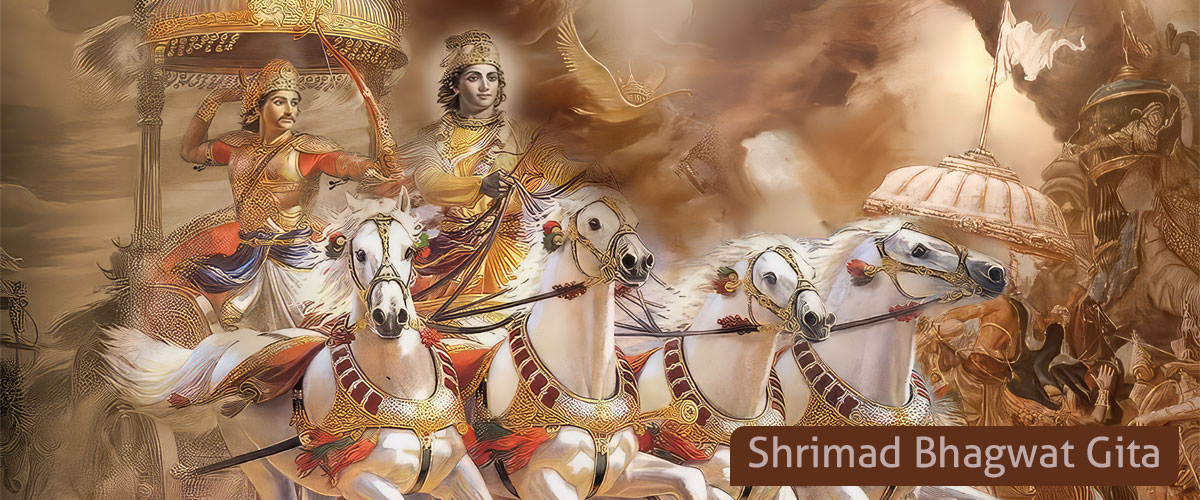
Arjuna is very much human – just like all of us. In fact, he practically represents us in this divine dialogue between the Lord and himself. All his questions are natural - the same questions that arise in our own minds as we read through this sacred text.
Towards the end of the previous chapter, the Lord explained various forms of Yajñas (sacrifices). These were meant to curb the never-ending chain of desires that seek fulfillment through the external world, gradually turning our focus inward - toward the Self. The intent was to renounce dependence on the outer world.
In His concluding remarks, the Lord tells Arjuna that one who renounces even actions (karma-sanyāsa) and has no more doubts about the eternal truth is no longer bound by the cycle of actions. This remark about renouncing actions, however, can be confusing. Naturally, Arjuna (and any reader) asks:
What is the right approach - renouncing actions (karma-sanyāsa), or the path of action (karma-yoga)?
This is perhaps the only question that the Lord answers in a single line - not because there isn’t more to say, but because the answer is so profound. The Lord clearly states:
The path of action is better than the path of renunciation.
The intent of renunciation is to experience true knowledge - and the path of action too leads to that same knowledge. Hence, to consider the two as different is ignorance. Since the end goal is the same in both approaches, taking up either with complete dedication leads to the same realization.
What follows is an elaboration of what exactly sanyāsa means.
Who is a Sanyāsi?
Lord Krishna explains that a Sanyāsi is one who neither hates nor desires anything, who is beyond all dualities — such as pleasure and pain, honour and dishonour - and who can easily remain free from attachment or longing.
The Lord further says that achieving such a state is very difficult without being engaged in karma-yoga; for one who is engaged in karma-yoga, it becomes much easier.
A raw diamond, dug out of the earth, will remain just a lump if left untouched - no different from a clod of mud. To make it worthy of being a jewel, it must undergo a process of purification - of rubbing away its impurities, of being cut and polished to shine! The process is indeed full of hard, sometimes painful actions.
But what is pain, after all? Isn’t it merely our reaction to being pulled out of our comfort zones? Such pain is a positive catalyst for change — we must embrace it to shine like a diamond.
How to Achieve Sanyāsa While on the Path of Action
In karma-yoga (the path of action), the advice is to give up the sense of entitlement to results — to accept outcomes as they come.
In a way, Sanyāsa Yoga is the “graduation” from Karma Yoga. It usually happens in this order — one first learns to perform karma-yoga in the spirit of Yajña. Over time, this practice curbs the desires that drive one’s actions.
Now, if there are no desires, does that mean no actions?
No! The Lord has already explained that non-performance of actions is not an option.
Then, what actions does one perform who no longer acts for self-gratification?
That is when one truly begins to live - using the body merely as an instrument to perform actions, dedicating their results to the Lord. Offering results to the Lord means offering them to society, to Prakṛti - for the greater good. How noble!
However, this can potentially inflate one’s ego. To handle this, the Lord advises us to adopt the mindset:
“Naiva kinchit karomi iti” - “I am not the doer.”
In essence, we must give up the pride of doing.
The Lord gives fascinating examples: one must adopt this mindset even during trivial, everyday actions — seeing, hearing, tasting, touching, smelling, sleeping, breathing, speaking, letting go, grasping, opening or closing the eyes. The moment we associate “I” with these actions, we develop likes and dislikes — wanting more or less of certain experiences.
This mindset — “Naiva kinchit karomi iti” — can arise only when we are convinced that the sense organs are merely engaging with sense objects, and that none of these interactions affect the inner being. What the mind perceives stays within the ego-centered mind; it never touches the inner divinity.
Giving Up the Sense of Doership — Is It Possible?
A simple example — newborn babies!
For the first few months, they are always in this state. They never seek “more” of anything. With their eyes open, they see — but nothing in particular. When fed milk, they drink only to quench hunger. They certainly don’t demand almond milk!
A baby doesn’t complain about the smell after peeing, nor does it smile because you’ve worn an expensive perfume. It doesn’t care whether you’re dark or fair — it smiles with the same innocent joy.
Essentially, babies do not associate ego with their perceptions — “Naiva kinchit karomi iti.”
Perhaps that is why we call babies representations of God!
And this applies not just to human babies — even piglets share these qualities.
It is only as they grow up that they begin to engage the ego in their actions — and eventually get blinded by it, mistaking the ego for their true self.
When we, as adults, have babies, perhaps they serve as living reminders of how to adopt the “Naiva kinchit karomi iti” mindset.
Babies Serve as an Example — But Is It Practical for Adults?
Sanyāsa is indeed a difficult path. But if one sincerely practices Karma Yoga — performing actions in the spirit of Yajña — then the sanyāsa attitude will naturally evolve.
Although “giving up the result of action” may seem unrealistic, it’s not uncommon. We can observe it being practiced, in varying degrees, in many walks of life.
For instance, in any successful team, members necessarily give up personal aspirations to some extent. When one works purely for the collective purpose, sharing results with others, they inspire the team — they become true leaders.
Such leaders naturally embody qualities of a Sanyāsi to a great degree. Think of Swami Vivekananda, Lal Bahadur Shastri, or Dr. A.P.J. Abdul Kalam — they truly lived these values!
In the context of seeking divine truth, this is the stage where one engages the intellect, mind, and faith entirely — always — in the Lord. Such a person remains undisturbed by success or failure, untouched by desires and their emotions. The Lord says, such a person can certainly attain liberation — right in this very lifetime.
Liberation from what? From the endless cycle of Birth and Death, Birth and Death of what:
Thoughts leading to desires
Desires leading to actions
Actions leading to emotions
Emotions leading back to thoughts and desires
Isn’t that true liberation?
When you break free from this cycle, won’t you see divinity everywhere? Then does bodily existence or non-existence even matter?
Liberation (moksha) is for you to decide — what do you truly seek freedom from?
DISCLAIMER:
This is our sincere attempt to summarise the Gitōpadeśa through a series of short blogs. This is not a full translation or commentary of the divine text. We seek forgiveness — from both the reader and the Lord — for inevitable omissions made to keep the blog concise.
These write-ups include both the writer’s personal reflections and summarised interpretations of various shlokas from the Bhagavad Gita. The intent is not to comment on the Gita, but to inspire readers to study it in its entirety.
The writer is neither a scholar nor a hermit — merely someone in between, with the firm belief that it is the Lord who makes him do whatever he does. Being human, he still errs. Please forgive all such mistakes.
